Sunday, June 10, 2012

Our Last Day in Florence

It's hard to believe that we've already been here for 2 weeks!  Tomorrow we get up bright and early to catch a train to Rome and start the second half of our program.  It's going to be quite a change for everyone -- the students have come to really love Florence, and they're not sure what to expect in Rome.  Neither am I, actually.  I don't know the city very well at all, so it's going to be an adventure for all of us.

I've been a little under the weather for the past few days, so I haven't done a great deal of wandering around.  I did take the students to see the Duomo, at last -- it's the most iconic building in Florence and we've been staring at the dome for 2 weeks now.  Unfortunately, a lot of the inside was blocked off for some reason so we couldn't even go and stand under the dome itself, which kind of sucked.  We did visit the Baptistery as well, though, which is possibly the oldest building in the city (it's been there for about a thousand years, literally) and so beautiful.

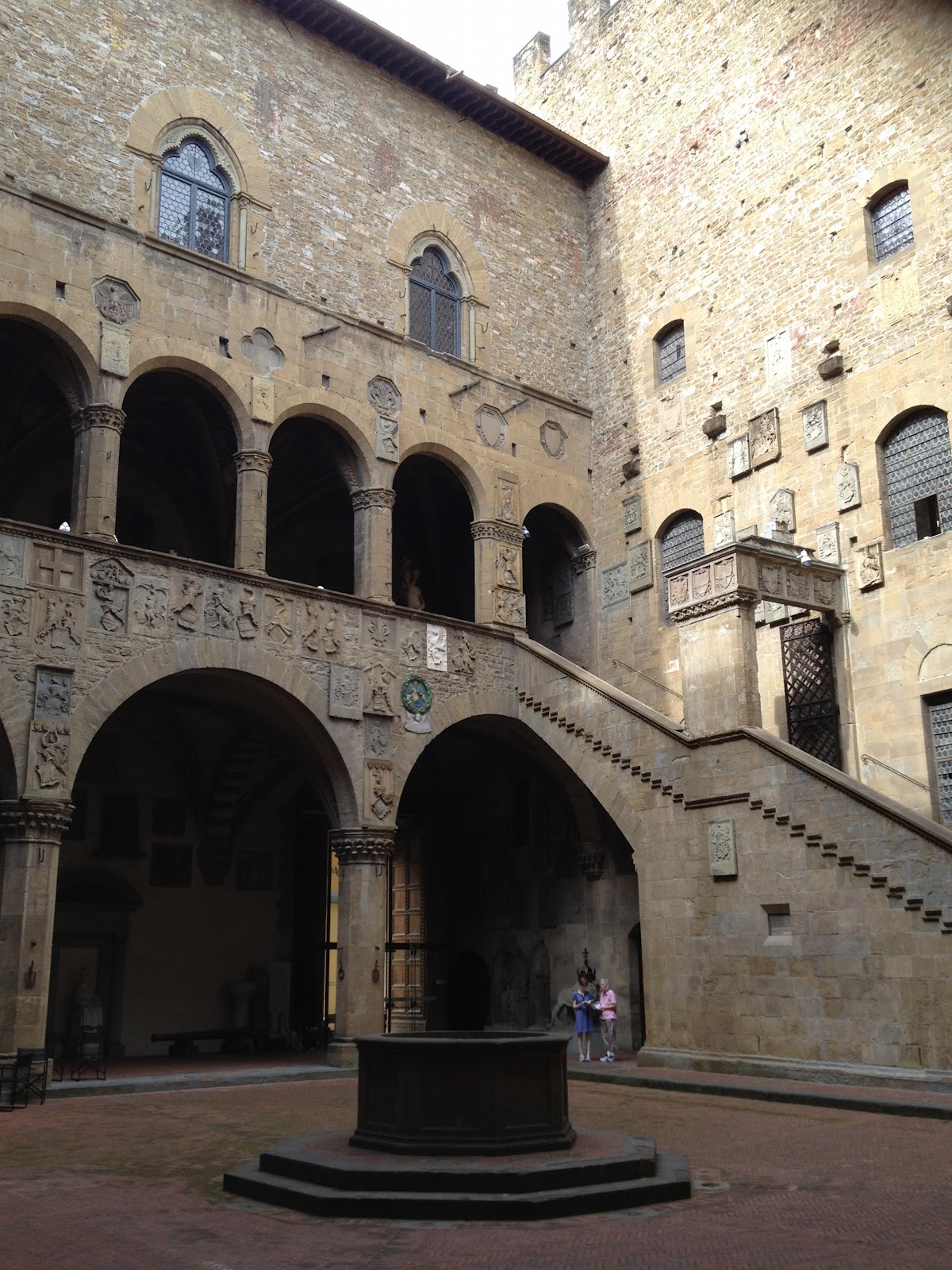
We had a free day on Friday, and I wandered over to the Bargello, which is just up the street from my apartment and which has one of the best collections of Renaissance sculpture in the world.  It was just as I'd remembered, and I had a great time wandering around, sneaking photos when the guards weren't looking.  Then I strolled over to the church of San Marco, which has a very cool museum that has preserved the original cells that the monks lived in centuries ago.  The walls are decorated with beautiful images by Fra Angelico, one of the best painters of the Renaissance.  This was also the monastery where the monk Savonarola began to preach against the excesses of 15th-century Florence, culminating in the famous Bonfire of the Vanities in which the wealthy as well as artists burned their possessions as a gesture of piety.  Of course, Savonarola was burned alive himself a couple of years later.  Ahh, the Renaissance.  Good times.

Yesterday we were going to visit the villa where Galileo was confined after his trial in 1633, and where he died in 1642.  I was really excited, as the house has been closed for years and years and we were going to be the second group to actually see inside.  Unfortunately, our day was ruined by Florentine public transportation.  The first bus we had to catch was 30 minutes late, which meant that we had to wait another 30 minutes for the second bus.  We ended up being an hour late for our scheduled tour, and no one answered the bell when we finally arrived.  I was crushed.  The poor students put a brave face on things, and we ended up having a class session sitting on Galileo's front steps, which ain't so bad, but I was really sad to have missed out on such a cool opportunity.  Ah well.

A few photos:


Random shot of the oldest church in Florence, tucked away in a tiny piazza.


The roof of the Baptistery, covered in an incredible mosaic.


Courtyard of the Bargello, which served as a prison for centuries before it became a national museum.

Donatello's David, the first nude sculpture of the Renaissance and one of the most famous bronzes in the world.


Jason and the Golden Fleece.


A monk's cell at San Marco, with one of Fra Angelico's paintings on the wall.


More Fra Angelico.


The outside of Villa Il Gioiello, the house where Galileo lived and died.


A bust commemorating "the divine Galileo."


Today is cleaning and packing, and perhaps a last stroll around, though it looks like it might rain.  I'm going to miss Florence, but to be honest I'm starting to get really annoyed by the swarms and swarms of tourists that are literally everywhere here.  Rome will have lots of tourists as well, of course, but it's a little more spread out and I don't think it will be as bad.  I guess we'll see!

More to come from Rome!

Wednesday, June 6, 2012

Birth and Death

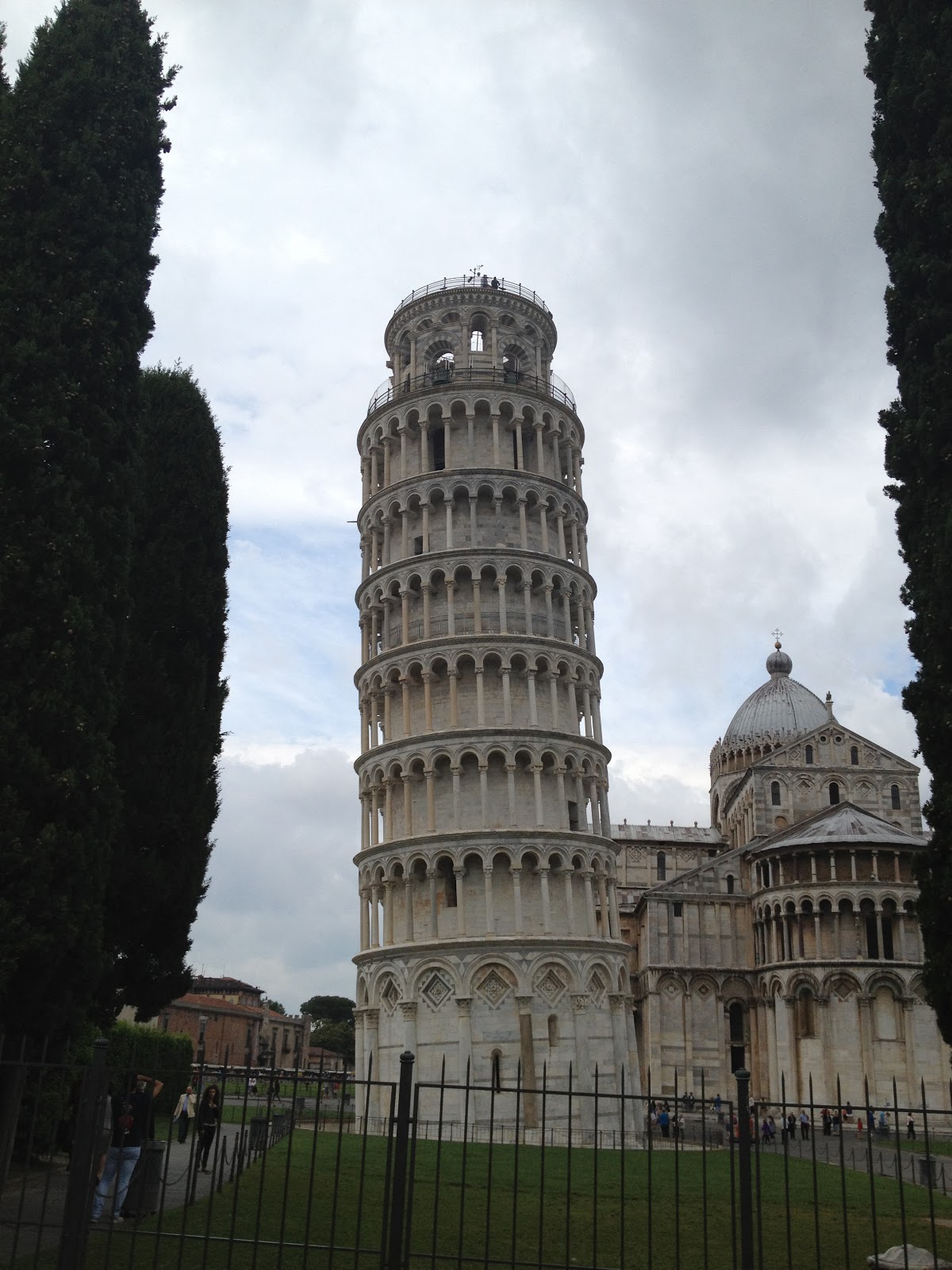
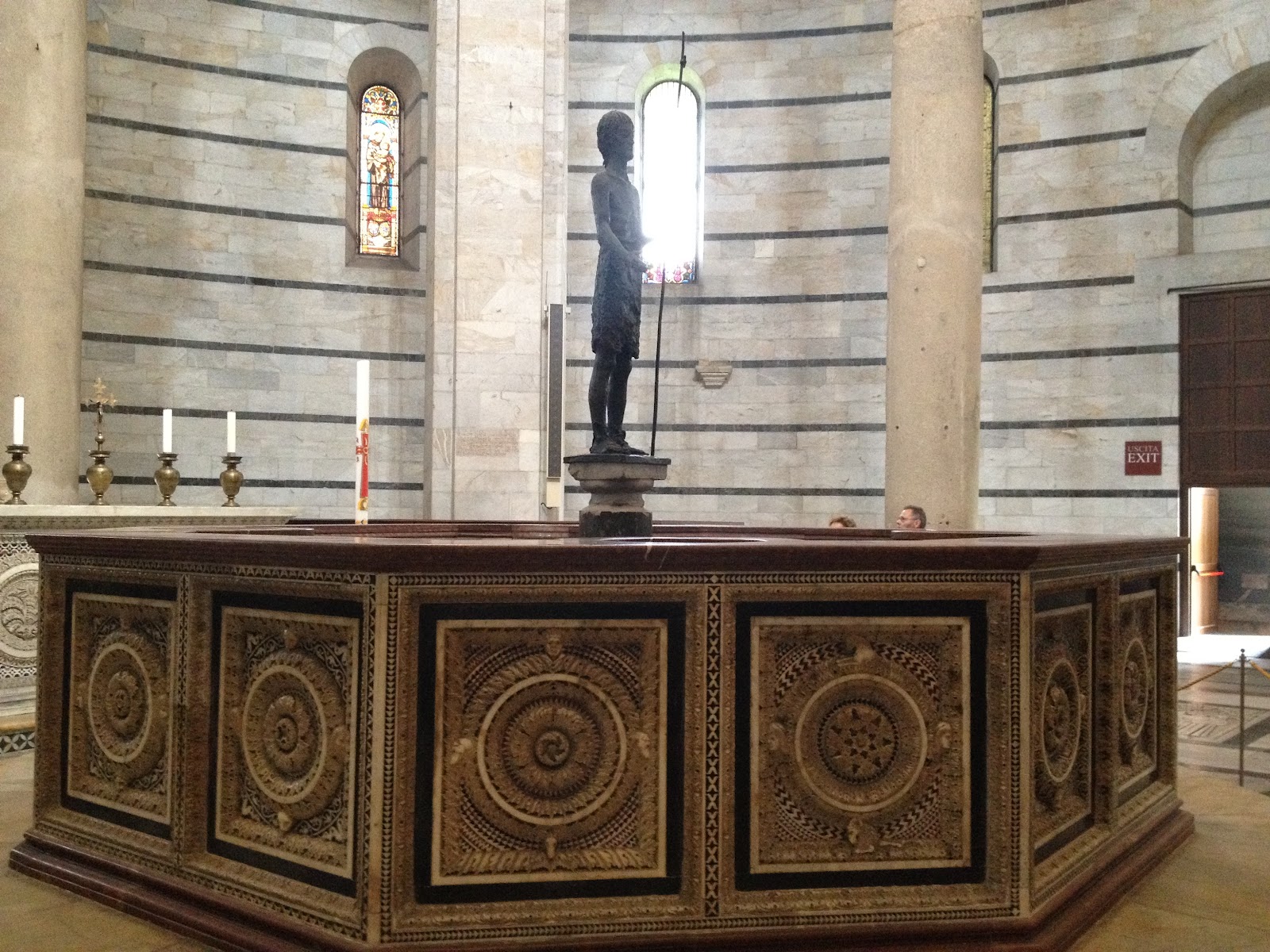
Our investigation of the life and times of Galileo continues!  On Monday we took a trip to Pisa, where Galileo was born.  It was a cool and breezy day, which made for a nice change from the more usual sticky heat.  With the help of a local guide, we explored the Campo dei Miracoli, where the cathedral, baptistery, and, of course, the leaning tower are situated.  It was very cool.  The baptistery is where Galileo was baptized, which made for a neat photo opportunity.


The Baptistery.


The font where Galileo was baptized.  Wheee!


According to our guide, this little figure of Hercules (in the center) was the first sculpted naked man to appear in a Christian church.   Neat.


There wasn't much else to see in Pisa, so after lunch we hopped back on the train and returned to Florence.

Yesterday, we fast-forwarded to the end of Galileo's life.  We started with a trip to the Museo Galileo, which has an amazing collection of scientific instruments and materials from the 15th, 16th, and 17th centuries.  My kind of place.  It had things like this amazing, huge armillary sphere (depicting the motions of the planets and stars in an Earth-centered universe) that was a wedding present for one of Galileo's patrons, the Grand Duchess Christina:


....as well as this example of an early "computer" -- a means of storing and categorizing information, designed originally by Athanasius Kircher, on whom I wrote my dissertation:


These are the last two surviving telescopes made and used by Galileo; below, in that fancy plaque, is the objective lens through which he first observed the moons of Jupiter:


Replicas of the equipment he designed and used to make his discoveries in physics:


.....and, of course, two of his fingers, a thumb, and a tooth, removed when he was reburied in 1733 and now preserved forever.  The larger "reliquary" was lost for over a century and was only rediscovered in 2010.


After our whirlwind tour of the Museo, we headed to Santa Croce, the church where Galileo is buried, along with Michelangelo, Machiavelli, and others.


Michelangelo's tomb.


Machiavelli.


Galileo's tomb.


After staring at tombs and walking on more than a few graves set into the floor of the church, we headed outside to the quiet and beautiful cloisters where the monks used to stroll.  Not a bad end to a fascinating day.

Alas, I seem to be coming down with a cold, so my last few days in Florence may not be perfect.  I'm going to see as much as I can, though!  We're going to visit the Duomo tomorrow (at last), and we're lucky enough to have a chance to visit the house outside Florence where Galileo was confined after his trial in 1633, and where he died in 1642.  That's on Saturday. 

Ciao for now!


Sunday, June 3, 2012

One Week In

So we're approaching our 1-week mark, though it seems like we've been here for much longer than that.  The weather continues to be sunny and quite warm, and we have continued our non-stop schedule of walking and visiting sites all over the place.

On Friday, we spent time in the Palazzo Pitti (once home to the Medici) and the Boboli Gardens, which were beautiful.  Great views across the city.  It was nice to see some actual grass and flowers, too.  And now for some photos....


(Villa Spelman, where I studied in grad school.  Awww.)


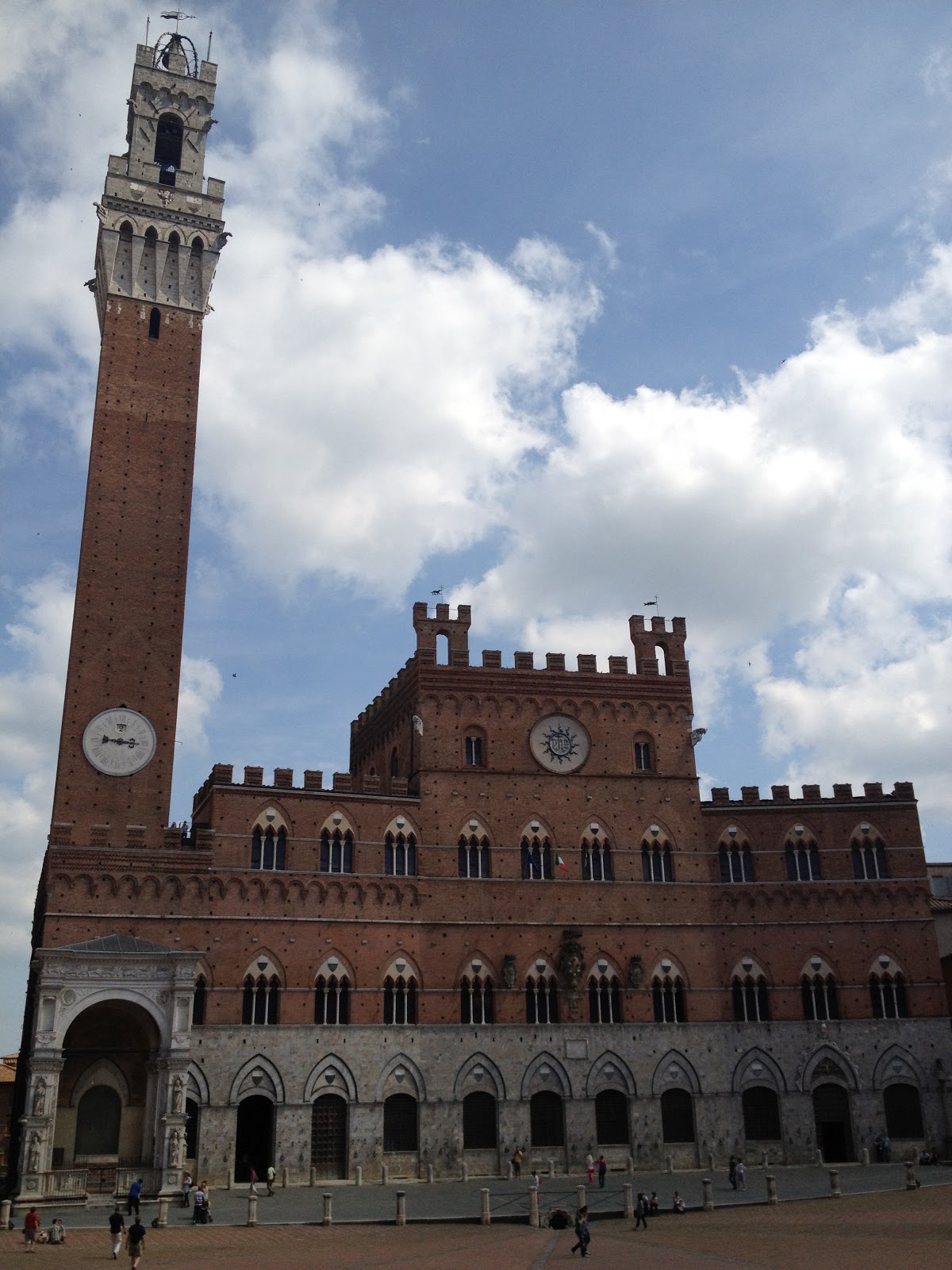
Yesterday, I traveled to Siena with about half of the students.  It's a small medieval city about 80km from Florence, and it's absolutely beautiful.  Very quiet, compared to Florence, with tons of hills and amazing views everywhere.  We did a LOT of hiking up and down the streets, but it was worth it!  I'd happily live there.


And then today, I dragged most of the students up and down and up all kinds of hills in Florence as we made our way up to the Piazzale Michelangelo, which has some of the best views of the city.  After our exertions, we sipped cocktails and looked out over the view, which made this pretty much the perfect Sunday.


Now it's time to relax.  Tomorrow we head to Pisa for the day, though it's supposed to rain so that may not be entirely fun.  I'm looking forward to it, though!

Ciao a tutti!

Thursday, May 31, 2012

Up To Our Eyeballs In Art

Day 3, and things continue to go well.  Yesterday the students were introduced to the Renaissance in style -- a tour of the Uffizi gallery, followed by a visit to the Accademia, home to Michelangelo's David.

Many of the students were pretty overwhelmed by the sheer amount of art in the Uffizi -- it's hard to know what to see.  The crowds didn't help.  There are some amazing things in there, though.  As one student pointed out today, a trip through the Uffizi is like a trip through time -- you watch as artistic styles change from medieval to Renaissance to early modern.  It's great stuff.

The Accademia, though smaller, has some great art as well.  Of course, the reason most people go is to see the David.  We've all seen pictures of it, but none of them can really capture the moment when you round a corner and see it towering up ahead.  It's a phenomenal piece of art.  What makes it even more rewarding is that, thanks to the work they did before we left the States, the students understand why Michelangelo created it: as a commentary on the victory of the small man over the tyrant, a message aimed squarely at his patrons, the Medici.  I think knowing that helped the students appreciate the David on a different level.

Speaking of the Medici, today was all about them: we visited the Palazzo Vecchio, where they once lived and ruled, and then saw the incredible chapel they built to house their tombs.  It was an illuminating glimpse into how they existed and thought about themselves. 

Sadly, I don't have many pictures at all -- most places don't allow photos (though the students haven't let that stop them!).  I have a few, though.


A random shot of the buildings and hills across the Arno.  A very Tuscan scene!


Cellini's statue of Perseus holding the head of Medusa, with the Palazzo Vecchio as backdrop.


No photos of the real David, but this was standing in a courtyard outside.  I think Michelangelo would approve.


Gelato break!


It's more palaces and art for us tomorrow, followed by a visit to the Boboli Gardens.  Finally -- grass!  Flowers!  I can't wait.

Ciao for now.

Tuesday, May 29, 2012

Day 1!

Well, we all made it.  I haven't actually seen any of the students yet (we're meeting up this afternoon), but I've been told that they're here and settling in.  Excellent.  I'm settling in as well -- my apartment is small but comfortable, in a building with its own little courtyard.   Santa Croce, where Galileo is buried, is just around the corner, which seems appropriate. 

I'm looking forward to seeing my students and getting our class started -- I think it might be a little tough for some of them to switch gears so quickly from tourist-mode to class-mode, but that's what we're here to do.

In the meantime....pictures!


The Palazzo Vecchio


Brunelleschi's famous dome on the Duomo -- still the largest brick dome in the world.


Spedale degli Innocenti -- once an orphanage and also designed by Brunelleschi, it's known today as the first genuine example of Renaissance architecture.


Ciao for now!


Friday, May 25, 2012

Here We Go...

Two cities.  Four weeks.  Fifteen students.  This is going to be great!

In a couple of days I'm heading to Italy, leading my first study abroad course.  We're following in the footsteps of Galileo Galilei, the mathematician and astronomer whose clash with the Catholic Church remains one of the best-known events in the history of Western science.  We start in Florence, where Galileo lived for many years and also where, well over a century before him, the Renaissance first took shape.  We'll visit the house where Galileo was confined following his trial in front of the Inquisition, and his ornate tomb in the church of Santa Croce; we'll see one of his fingers, preserved in a reliquary, next to the telescope lens through which he became the first person to observe the moons of Jupiter; and we'll visit the palaces and gardens of the powerful Medici family, who helped to shape the Renaissance and who later became Galileo's patrons and protectors. 

Traveling to Rome, we'll have a chance to consider why Galileo clashed with the Church, and what exactly was at stake in his claims that the Earth moved around the sun.  We'll visit the very spot in Rome where he first demonstrated his telescope to a collection of cardinals and virtuosi, as well as the observatory at the Collegio Romano where Jesuit priests tried either to prove or refute Galileo's heretical claims.  Later, we'll see the actual recantation that Galileo signed in 1633 after his trial came to a close, and we'll retrace the route taken by Dan Brown's characters in his Angels and Demons as we consider why the mythology of Galileo remains so powerful today.

It's going to be a whirlwind, but I can't wait to introduce my students to this history as well as to everything Italy has to offer.  When I can, I'll post updates and photos here.  Stay tuned!